Where is TV advertising heading? Insights from IAB’s TV+ Growth Summit
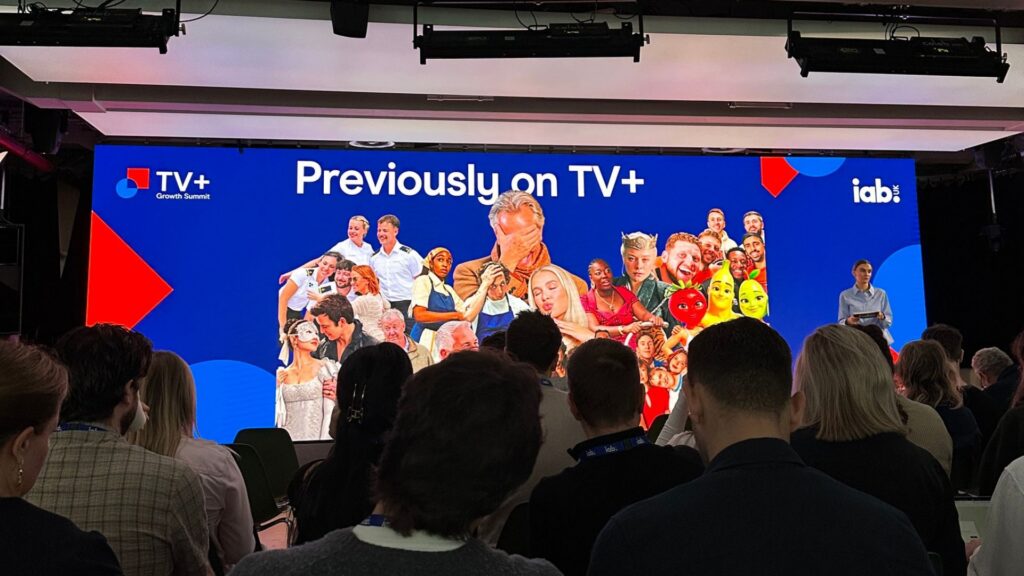
Our team went to the IAB TV+ Growth Summit in London last week to find out exactly where TV advertising is heading. Catch all the key insights in our latest blog.
About this post
Published
Author
November 17, 2026
Maite Gonzalez
Boundaries more blurred than ever
TV has given us plenty to talk about in the past 12 months.
From the BBC signing a partnership to produce content specifically for YouTube, Instagram pushing into long form, to Channel 4 recently launching its first short form drama at 90 seconds per episode – these were some of the headlines that set the stage right at the summit’s opening session.
But there’s more. AI generated content has gone mainstream, and BVOD continues to grow. Viewers simply want to watch whatever they want, whenever and wherever they want, and are embracing a much more multifaceted landscape. Research shared at the summit revealed that UK TV+ ad spend hit £3.2B in 2025, and has already reached £1.7B in the first half of 2026.
Turning this fragmented reality into a coherent, measurable media plan is the real challenge for brands. Across a packed day of sessions from broadcasters, platforms and researchers, several clear themes emerged on how marketers can navigate this new era.
Redefining the economics of TV
In the past, share of time and share of media were roughly equal, which framed how the entire industry bought and measured ads. Today, a minute is no longer just a minute. Value is now dictated by engagement intensity, targeting, attribution, brand safety and commercial density.
AI is accelerating this shift. As cheap, AI driven production floods the market with supply, capital will naturally flow toward the platforms and open web ecosystems that remove friction and offer trusted measurement. While streaming spend is largely a redistribution of linear TV budgets rather than brand new money, we are heading toward major market consolidation.
As platforms bid for talent, creators are starting to act like TV networks, and vice versa. As Daniel Knapp, Chief Economist at IAB UK put it “To define is to limit.” There is still a massive gap between our industry’s vision and current buying realities, and bridging it requires rethinking how we value attention.
How viewers actually define TV
Marketers love to categorise media by device, platform or funnel stage, but audiences don’t think that way. New consumer research presented at the summit by Elizabeth Lane, HEaf of Insights at IAB UK showed that only 6% of people define TV as a physical device. Instead, 90% define it simply as content (an entertainer and an emotional escape). In fact, 88% consider most streaming services to be TV, and 55% of consumers now view YouTube as TV.
When it comes to advertising, 92% of viewers use ad supported services across linear and digital, often mixing and matching paid ad free tiers with ad funded ones. Crucially, even half of self confessed ad avoiders are willing to sit through ads if it means getting to the content they actually want to watch. They are far more receptive when ads are short, skippable, and relevant to what they’re watching.
Culture over trends: Rebuilding brand equity
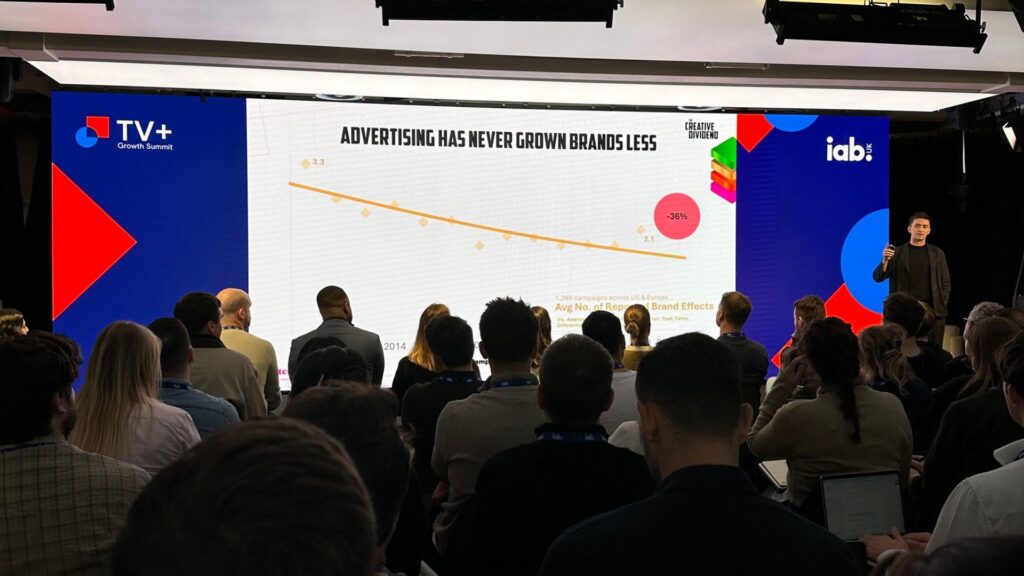
In a standout session, Andrew Tindall from System1 delivered a wake up call: the industry has never spent more on advertising, yet advertising has never grown brands less. With AI making it easy to copy products and undercut prices, strong brand equity is the ultimate differentiator, especially as consumers increasingly rely on LLMs to recommend products.
Tindall outlined four shifts marketers must make to get back to genuine brand building:
- Build campfires, not fireworks: Stop mistaking fleeting social trends for real culture. Brands grow by tapping into shared, enduring cultural moments (like Formula 1, the Paralympics, or beloved entertainment franchises) rather than chasing viral flashes in the pan.
- Break the addiction to short termism: Over indexing on immediate performance metrics leads to poor media choices that starve future demand.
- Plan for attention: High-attention environments like TV act as a springboard for creativity and build lasting mental availability.
- Embrace the creativity stack: Every generic AI generated ad looks the same. To stand out, brands need distinctiveness – genuine emotion to turn revenue into profit, and more importantly, relentless consistency. In his own words “Only marketers get bored of their own ads; audiences need repetition to remember you.”
Ultimately, great advertising is showmanship with a commercial goal. Spend 5% of your effort closing immediate sales, and the other 95% entertaining your audience to create future demand.
Intention spans, fandom, and the new storefront
Rather than worrying about shrinking attention spans, Netflix urged marketers to focus on intention spans: how viewers deliberately choose where to spend their time. Nine in 10 viewers seek out content that offers an emotional connection, and 72% of Gen Z say watching the same shows gives them a sense of belonging.
Attention today is chosen, shared, and remembered.
To capture it, brands need to design for the in-between moments and make an impact in the final three seconds of an ad, not the first.
Disney echoed this sentiment, noting that true engagement comes down to enduring appeal and fandom, making content part of a community’s everyday world. And when you capture that deep, lean back engagement, it drives real business outcomes.
The creator convergence
Top creators command global audiences built on personal trust rather than a specific show format, effectively operating as independent production houses.
Currently, creator led content accounts for around 4% of ad spend, though markets like the US are rapidly scaling that number, and the UK is racing to catch up.
Integrating creators into TV style campaigns is a huge opportunity that can’t be overlooked, but requires a fundamentally different way of working and a clear value exchange.
In summary
The takeaway is clear: the screens, formats, and buying models are evolving at breakneck speed, but human nature hasn’t changed. Whether it’s a 90 second social drama, a creator led series, or a blockbuster movie, the winners in the new TV+ landscape will be the brands that respect the viewer’s experience, embrace true cultural relevance, and aren’t afraid to entertain.